
Field Hockey Shack guides
The field hockey equipment guide
What you actually need to play, what the rules require, and how sticks differ from one another once you get past the paint. Written by people who fit this gear for a living, for players and parents buying it for the first or fifteenth time.
Start here
What a field player needs
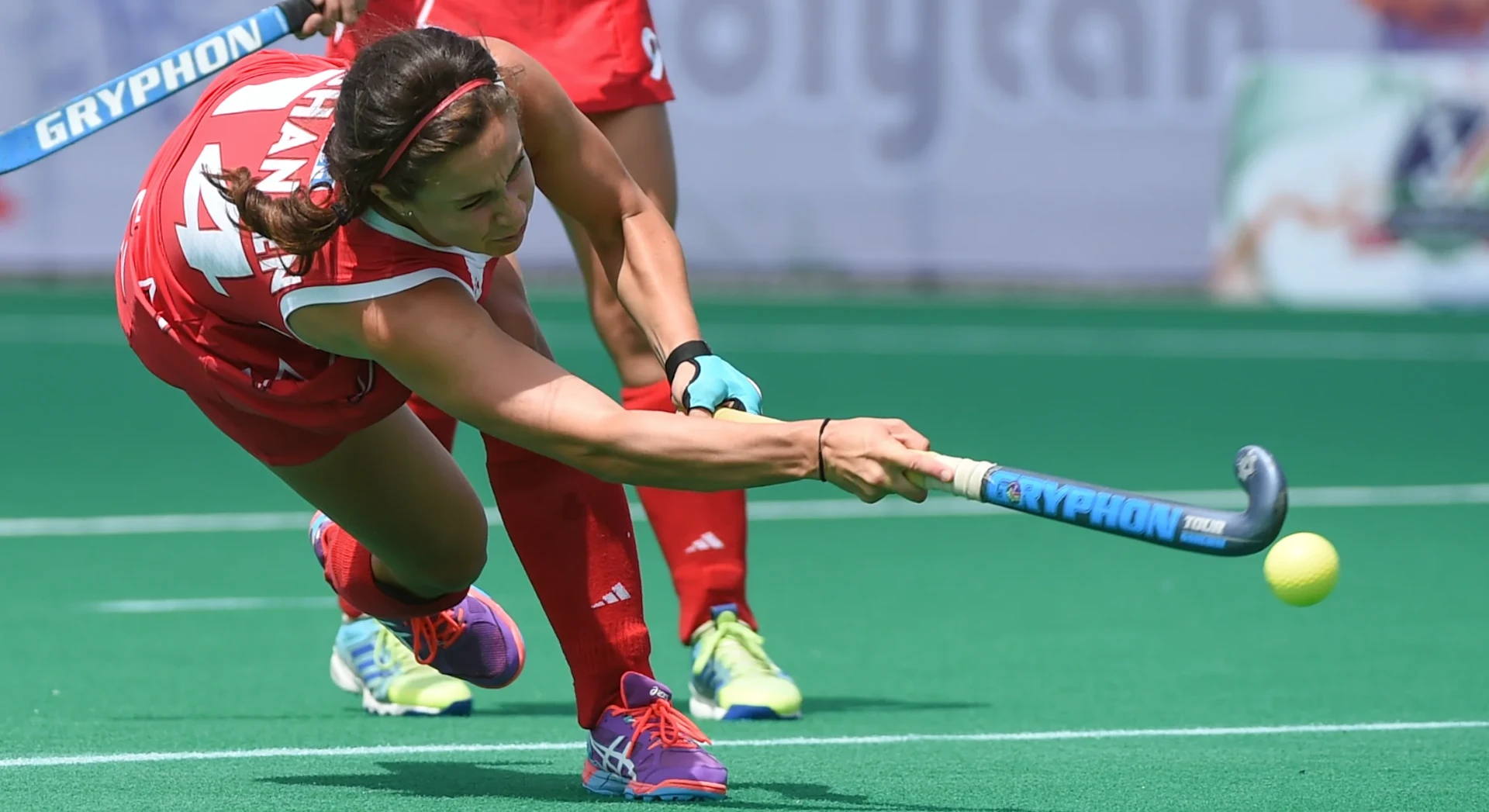
Stick
EssentialThe one piece worth taking time over. Length is set by your height, and the bow and carbon level by how you play. Our sizing guide walks through both.
Mouthguard
EssentialRequired in almost every league in Canada. Boil-and-bite works for most players; a dentist-made guard is worth it for anyone in braces or playing at a representative level.
Shinguards
EssentialMeasured from just below the knee to the top of the boot, not by shoe size. They must sit inside the sock and inside the shoe collar.
Long socks
EssentialNot just uniform. Umpires check that the shinguard is fully covered, and a shinguard that slides is a shinguard that is not protecting anything.
Turf shoes
EssentialA low-profile multi-stud or dimpled rubber sole. Not soccer cleats: moulded studs grip artificial turf too hard and are hard on knees and ankles. Not high-tops, because the shinguard has to sit inside the collar.
Glove
OptionalOptional but near-universal now. Worn on the left hand to protect the knuckles when the stick is low and flat in 3D skills.
Face mask
OptionalRequired for defenders on penalty corners in most competitions, and increasingly worn by all corner defenders. Clear moulded masks are the standard.
Bag
OptionalSized by the longest stick it must carry, not by the player. A 38.5 inch stick will not fit a bag built around 36.5 inch.
Sizes for every one of these are in our sizing guide.
Between the posts
What a goalkeeper needs
The full complement
- Helmet or face mask with a cage
- Throat protector
- Mouthguard
- Hand protectors: left and right are different shapes
- Body armour and arm guards
- Padded girdle or shorts
- Leg guards
- Kickers over the shoes
Goalkeeping is the one area where buying blind goes wrong most often. Kit is sized by height and shoe size together, in age bands rather than one universal chart, and the bands differ significantly between brands: a large in one range is a medium in another.
The test that matters: with the keeper crouched in a ready position, the leg guard should cover from above the knee down to the top of the kicker with no gap. Standing up straight tells you nothing.
Growing keepers are expensive keepers. We would rather size a set live with you on camera than have you guess a chart.
Fit a Keeper Set on VideoChoosing a stick
Stick levels, honestly
Buy a stick for how you play, not for the position you are listed at. Modern sticks are no longer built around forward or defender roles. Carbon content and bow shape decide far more about how a stick behaves than any position label ever did.
Beginner
Wood or 100% fibreglassBuilt to teach technique, not to generate power. Soft, forgiving and cheap enough to survive a first season of being dropped, scraped and left in the rain. The right choice for anyone still learning to trap cleanly.
Competitive
Under about 20% carbonFlexible and quiet in the hands, with enough power for a developing player. Less vibration than a high-carbon stick, which matters a lot when your first touch is still a work in progress. Covers a wide span of club and school players.
Advanced
Roughly 40 – 70% carbonPowerful but still forgiving. Softer touch and more control than an elite stick, and the range most regular adult club players should be shopping in.
Elite
About 70 – 100% carbonThe stiffest and most powerful sticks made, and the least forgiving. Superb if your receiving is clean; punishing if it is not. Representative and international players live here.
Weight
Brands quote a target weight for a 36 – 36.5 inch stick. Assume roughly 10 grams for each additional inch. Lighter is quicker in the hands; heavier carries more through a hit.
Vibration
More carbon means a stiffer stick, and a stiffer stick stings more in the handle. Sting is not damage. It is the price of power, and it fades as the stick warms up.
Shape matters
Bow profiles
Every composite stick curves from handle to toe. Most sit at 19 mm or more; elite sticks run close to the 25 mm legal maximum. Where the peak of that curve sits is what changes how the stick plays.
Regular bow
The highest point sits in the middle of the shaft, usually 20 – 25 mm. Even help across every skill and the easiest profile to hit flat with. The traditional choice.
Medium bow
A gradual curve that hybridises the classic feel with the advantages of a lower bow. Genuinely versatile, and a good default if you play everywhere.
Low bow
Around 25 mm with the peak close to the toe. Makes lifting, aerials and drag flicking noticeably easier, and rewards dynamic ball movement.
Extreme low bow
Maximum help with 3D skills, dragging and drag flick consistency. A specialist shape: brilliant in the right hands, awkward in the wrong ones.
Gryphon names its shapes rather than numbering them. see the Gryphon shape guide.
The numbers
Balls, goals and what the rules say
The goal
12 feet wide, 7 feet high, 4 feet deep, with 18 inch backboards inside the base.
The ball
Solid core, roughly 156 – 163 grams. Dimpled balls suit water-based and sand-dressed turf; smooth balls are common indoors.
The stick
Maximum 737 grams, must pass through a 51 mm ring, bow depth limited to 25 mm, smooth rounded back and no sharp edges.
Playing surface
Water-based turf is fastest and hardest on shoes; sand-dressed and sand-filled turf grips more. Both need proper turf soles, not cleats.
Quick answers
Common questions
What equipment does a field hockey player need?
A stick, a mouthguard, shinguards, long socks that fully cover the shinguards, and turf shoes. A protective glove on the left hand is optional but very common. Everything else is comfort or performance.
What protective equipment must a field hockey goalkeeper wear?
A full set: helmet or face mask, throat protector, mouthguard, hand protectors, body armour and a padded girdle, leg guards and kickers. Goalkeepers are not permitted to play without their protective equipment.
How heavy can a field hockey stick be?
The Rules of Hockey cap stick weight at 737 grams, and the head must pass through a 51 mm ring gauge. In practice almost every stick sold weighs far less than the limit; most adult sticks land between 520 and 580 grams.
What size is a field hockey goal?
A field hockey goal is 12 feet wide, 7 feet high and 4 feet deep, with backboards 18 inches high along the inside base.
What is the difference between a dimpled and a smooth field hockey ball?
Both have a solid core. Dimpled balls are preferred on water-based and sand-dressed turf because the dimples cut friction and keep the roll consistent; smooth balls are typical for indoor and casual play.
Sizing guide
Every measurement, stick to shoes.
Is my stick broken?
Probably not. Here's how to tell.
Gryphon Canada
Canada's official Gryphon distributor for 25 years.
Buy it once, buy it right
Book a free Zoom or FaceTime call and we'll go through the whole kit list with you on camera: stick, protection, shoes, keeper gear. Fifteen minutes, no cost, no obligation.
Book a Free Video FittingVancouver and coast to coast
Field hockey equipment in Vancouver, shipped across Canada
Field Hockey Shack is a specialist field hockey store in West Vancouver, British Columbia. Players from West Vancouver, North Vancouver, Vancouver, Burnaby, Richmond, Surrey and the Sea to Sky corridor come in to hold the sticks before they buy. Everyone else gets the same advice on a free video call, and the gear goes out to them coast to coast.
In store in West Vancouver
Suite 100, 1525 Bellevue Ave, West Vancouver. Try the bow shapes, get measured properly, and walk out with a stick that fits the player rather than the box it came in.
Store details and directionsAnywhere in Canada
Victoria, Calgary, Edmonton, Winnipeg, Toronto, Ottawa, Montreal, Halifax and every small club in between. Book a free Zoom or FaceTime fitting, we size the player on camera, then the gear ships to your door.
Book a free video fitting